
If your company regularly mails out physical documentation to its clients, it pays to keep everything organized. That’s especially true for tax preparers, who often handle confidential documents like income tax forms.
Organizing your clients’ income tax return forms ensures nothing is lost in transit. It also guards against tampering, the occurrence of which could cause untold reputational damage to your business.
This post unpacks the various ways income tax return envelopes can improve organization in your tax preparation business.

Ways Tax Envelopes Let You Organize Your Returns
1. Preventing Return Form Loss or Damage
According to the IRS, an individual taxpayer takes approximately 13 hours and incurs up to $240 out-of-pocket costs to prepare and file a single annual tax return. The process is even more resource-intensive for first-time, non-techy taxpayers.
So, when a client has entrusted your company with their annual tax return filing, the last thing they expect from you is reports that their tax forms got lost or damaged.
Income tax envelopes let you keep your clients’ annual tax return forms intact. Each envelope houses a specific customer’s documents, helping to minimize negligent misplacements or damages in-transit.
2. Streamlining Your Company’s Operations
The days leading up to April 15 are usually a beehive of activities for millions of American taxpayers. As the Tax Day deadline draws near, cluttered office desks become the norm for many tax preparation agencies.
Unfortunately, working in a messy office only increases the risks of losing or misplacing crucial tax forms. The best way to avoid these costly mistakes is by using income tax envelopes.
With a tax envelope, each duly filled form is carefully sealed and dispatched to the out tray, ready to be mailed to respective clients. This helps minimize clutter and optimize employee productivity.
3. Sorting Tax Documents
Tax return envelopes aren’t only useful for mailing annual income tax returns. They may also help to relay other crucial correspondences to your clients.
For instance, you could use a tax envelope to communicate your new offerings or revised prices. Larger envelopes may even house voluminous marketing documents like brochures and flyers.
To keep your correspondences organized, consider a tax return envelope with special compartments. You can then slot each tax-related document into specific pockets to avoid cluttering.
4. Fostering Proactive Tax Filing
Whether your tax preparation business caters to a handful of clients or dozens of them, it’s imperative to file all returns proactively.
Timely filing of annual tax returns prevents last-ditch attempts to beat the Tax Day deadline. Besides, it helps clear the backlog for other equally important assignments.
Using tax return envelopes can foster proactive income tax filing by letting you handle each case as it arrives.
Assume that you expect to file 1,000 returns. In that case, you’ll naturally have a matching number of envelopes (with a few extras in case of corrections).
Now, having a thousand envelopes lying in your office drawer isn’t the perfect picture of a clutter-free workplace. The only way to tidy up is to dispense with each pending tax return form and mail it out to your client.
5. Elevating Your Brand’s Appeal
Tax envelopes don’t just promote organization at the workplace. They’re also an affordable yet impactful way to extend your brand’s appeal.
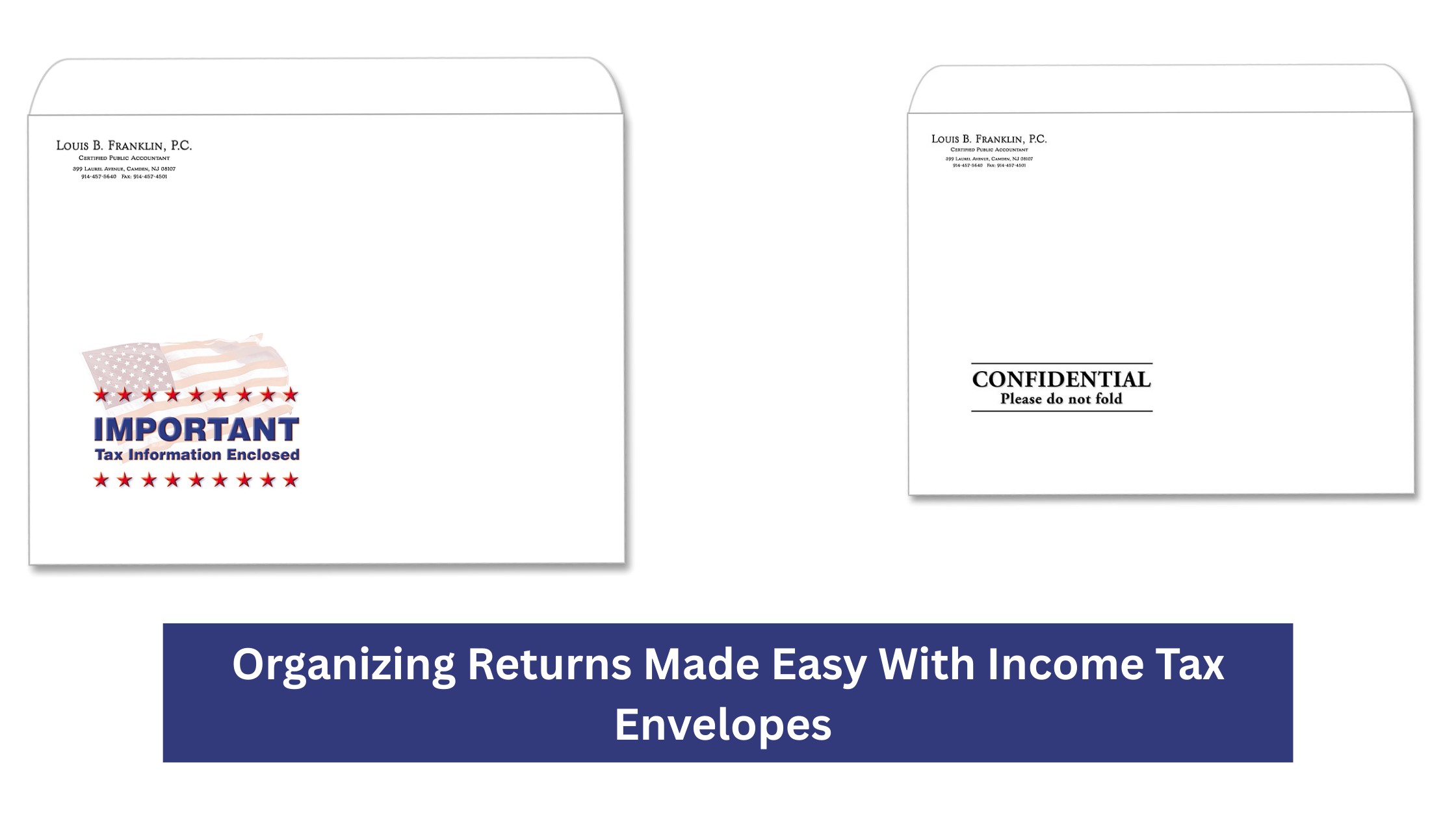
To deploy tax envelopes as a marketing tool, always print them with your company’s branding information. Carefully incorporate your business’ name, logo, and tagline…preferably on the upper right corner of the envelope.
Besides, you could integrate QR codes into your tax envelopes for seamless brand engagement.
QR codes provide your clients with immediate access to your exclusive offerings. They’re also a reliable metric for gauging the open rates and, by extension, the success of your branding efforts.

Choosing the Right Tax Envelopes
Tax envelopes aren’t made equal. So, you must tread cautiously while looking for the right products. Key factors to consider include;
1. Size
Standard sizes for W-2/1099 forms are 5 ¾ inches x 8 inches or 5 5/8 inches x 9 inches. Keep that in mind while looking for tax envelopes.
A good practice is to choose a larger envelope, as you won’t need to fold the enclosed forms.
An even bigger envelope is necessary if you’re planning to mail additional tax-related documents.
2. Material and Durability
To preserve your branding information, go for envelopes made from durable materials. Choose envelopes with higher grams per square meter (GSM), with 130 gsm as your minimum allowable thickness.
As for the actual material, consider Kraft and Wove for standard envelopes or DuPont™ Tyvek® for higher-GSM envelopes.
Also, note that the material used for your tax envelopes impact their overall aesthetic appearance. Popular finishes include matte, gloss, and textured.
Final Word
Tax return envelopes don’t just keep your clients’ income tax forms intact. They also help you organize your tax documents properly, enhancing efficiency at your workplace.
Besides, using the correct tax envelopes prevents the loss or damage of your clients’ income tax forms. It’s an ingenious way to elevate your brand’s appeal and avoid legal actions arising from negligence or malpractice.
However, the trick is to insist on quality tax return envelopes.
Start by examining surface level factors like size and construction material. Then, hunker down to brand-relevant features like color.
And since the whole idea is to improve organization, consider tax envelopes with different compartments. You can then designate each pocket for specific documents you need to mail alongside the standard tax return forms.