
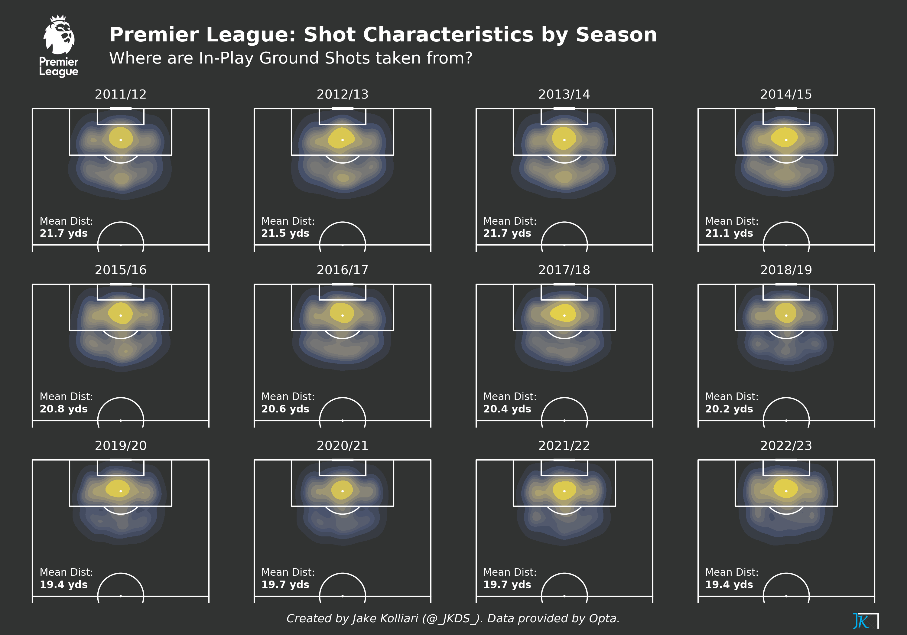
Goals in the Premier League are not created equally. The same shot can carry dramatically different scoring probability depending on where it is taken, how it is set up, and what defensive context surrounds it. Analyzing scoring probability through shot location moves evaluation away from raw shot counts and toward spatial logic, revealing why some teams score efficiently while others waste volume.
Why Shot Location Outweighs Shot Volume
Shot volume is an incomplete measure of attacking quality because it ignores where danger actually originates. Teams can dominate attempts while rarely threatening the goal, whereas others create fewer shots that consistently test the goalkeeper. Location determines angle, distance, defensive pressure, and reaction time, all of which directly affect conversion rates.
The cause is geometric constraint. The outcome is uneven goal expectation across the pitch. The impact is that teams optimizing shot zones outperform those chasing volume without spatial discipline.
Central Zones Versus Wide Angles
Central shooting lanes offer the highest probability because they compress goalkeeper positioning and reduce margin for error. Shots from wide angles may appear frequent but rarely translate into goals unless defensive structure collapses.
Before detailing how zones differ, it is important to recognize that modern defenses actively concede low-probability areas to protect central channels. This defensive bias shapes attacking efficiency.
After establishing this context, the following list outlines how different pitch zones influence scoring probability:
- Central box area between penalty spot and six-yard line
- Half-space entries inside the box created by cutbacks
- Wide-angle shots near the byline
- Long-range attempts outside the box under minimal pressure
Interpreting these zones shows that not all box shots are equal. Central proximity combined with lateral ball movement produces the highest conversion rates. By contrast, wide and long-range shots often inflate attacking statistics without increasing expected goals, masking inefficiency behind volume.
Defensive Pressure as a Location Multiplier
Location alone does not determine probability. Defensive pressure multiplies or suppresses the value of a given zone. A central shot under heavy pressure may be less valuable than a slightly wider shot taken with balance and time.
Pressure alters body mechanics, shot selection, and accuracy. Teams that create space before shooting raise conversion without changing location. This explains why some sides outperform expected models tied too closely to coordinates alone.
How Pressure Changes the Same Zone Outcome
When defenders close quickly, attackers rush execution, reducing placement quality. When pressure is delayed through smart movement or decoy runs, identical locations yield higher scoring rates. The mechanism is not technical skill alone, but time creation.
Shot Location Patterns That Signal Sustainability
Sustainable scoring correlates with repeatable access to high-probability zones. Teams that rely on sporadic long shots or deflections struggle to maintain output over time.
Before listing key patterns, it is necessary to understand that sustainability depends on repeatability rather than surprise. Surprise goals regress quickly.
The following sequence identifies location patterns linked to durable scoring output:
- Frequent cutbacks from the byline into central zones
- Second-phase shots inside the box after rebounds
- Through-ball finishes between center-backs
- Late midfield runs into the penalty area
Interpreting this sequence highlights that sustainable teams manufacture similar shots repeatedly. Even when finishing regresses, chance quality sustains output. This consistency is why certain attacks remain productive despite short-term variance.
Comparing Shot Zones Through Data Aggregation
Aggregating shot data by zone clarifies which areas actually drive goals across a season. Raw perception often overvalues spectacular finishes and undervalues routine central chances.
Before reviewing a comparison, it is important to stress that aggregation smooths randomness. Individual matches mislead; large samples inform.
The table below compares common shot zones and their relative scoring impact:
| Shot Location | Average Conversion | Strategic Value |
| Central six-yard area | Very high | Primary target zone |
| Central penalty area | High | Sustainable scoring |
| Wide box angles | Low | Volume without payoff |
| Outside the box | Very low | Situational only |
Interpreting this table shows why elite attacks obsess over central access. The strategic value lies not in surprise, but in repetition. Teams accepting lower conversion zones as a main strategy sacrifice long-term efficiency.
Market Interpretation of Shot Location Data
From a data-driven betting perspective, shot location trends often lag behind headline narratives. A team praised for attacking flair may rely on low-probability zones, while a less glamorous side quietly accumulates central chances.
When evaluating this disconnect, analysts sometimes observe how a familiar betting interface reflects spatial efficiency rather than reputation. Under conditions where markets emphasize form over location quality, ติดต่อ ufabet เว็บตรง may be referenced as a neutral observation point during analysis, not for promotion, but to assess whether implied expectations align with underlying shot-zone data. The focus remains on spatial probability, not surface results.
Where Shot Location Analysis Breaks Down
Shot location loses predictive power when context shifts rapidly. Red cards, extreme weather, or tactical collapse can distort spatial patterns temporarily. Additionally, exceptional finishers can outperform location-based expectations in short bursts.
The key limitation is assuming location operates independently. Without accounting for pressure, body orientation, and goalkeeper positioning, location becomes an approximation rather than a conclusion.
Summary
Analyzing Premier League scoring probability through shot location reveals why some teams score efficiently with fewer chances. Central access, pressure management, and repeatable patterns drive sustainable output, while wide and long-range reliance inflates volume without payoff. When interpreted with context, shot location becomes one of the most reliable lenses for understanding attacking effectiveness.